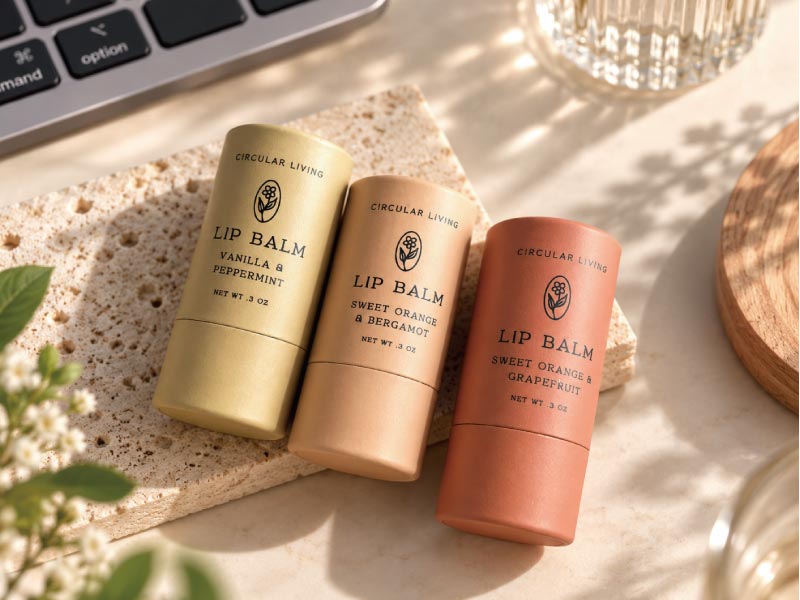
For hot-filling lip balm paper tubes, temperature is often the first thing brands want to confirm. How hot can the balm be before it affects the packaging? What should you do if the balm leaks after filling? And how can you know whether the tubes are ready for mass production?
From our experience working with paper lip balm tubes, these questions cannot be answered by temperature alone. The balm formula, inner liner, tube construction and actual filling process all play a part. Before committing to a large production run, it is important to test the complete packaging with your own formula rather than rely on a general temperature recommendation.
1. What Is the Recommended Filling Temperature for Paper Lip Balm Tubes?
There is no single filling temperature that works for every lip balm formula and paper tube combination. The right temperature depends on how the balm flows, the selected liner and how the packaging performs under the actual filling conditions.
Why We Use Around 70°C as a Reference Point
In our own testing, around 70°C (158°F) has been a useful reference point for certain lip balm formulas and liner setups. This recommendation comes from our experience with the materials and constructions we have tested. It should not be treated as a universal maximum temperature for every paper lip balm tube.
A different formula or liner may require a different filling condition. Even when two balms look similar, their melting characteristics and flow behavior may not be the same.
That is why we recommend confirming the temperature with the actual product and packaging combination. If your balm needs to be filled at a higher temperature, do not assume the tube will perform well simply because another formula worked at that temperature. Test the specific setup first.
Why a Lower Filling Temperature May Be Preferable
When practical, use the lowest temperature that still allows the balm to flow smoothly and fill the tube properly.
Excessive heat can put additional stress on the liner and the bonded paper structure. However, lowering the temperature too much can also create problems if the balm becomes too thick to fill evenly or starts to solidify before filling is complete.
The goal is not simply to make the filling temperature as low as possible. It is to find a workable temperature for the formula while keeping the packaging in good condition.
If you are still refining your production process, our guide on how to fill paper lip balm tubes provides additional practical filling guidance.
2. Why Your Lip Balm Formula Matters as Much as the Liner
Choosing a suitable inner liner is important, but the liner should not be evaluated separately from the product it will contain.
Different formulas behave differently during filling and after cooling. Their viscosity, melting characteristics and overall composition affect how easily the balm flows into the tube and how the finished product behaves once it solidifies.
For example, a formula that pours easily at one temperature may become too thick at a lower temperature. Another formula may remain fluid for longer, changing how much time the packaging is exposed to heat during filling.
These differences matter when selecting a tube and establishing a filling process.
Heat Resistance Is Not the Same as Formula Compatibility
A liner’s ability to withstand a certain temperature does not automatically mean it is suitable for every lip balm formula.
The complete packaging needs to work with the actual product. A formula with a particularly high oil content, for example, may require more careful liner selection and testing. This does not mean that an oily formula cannot be used in a paper tube; it means that suitability should be confirmed rather than assumed.
If your formula has unusual characteristics or you have experienced leakage or oil staining with previous packaging, share this information with your supplier. It can help guide liner selection and identify what should be checked during sample testing.
The most reliable approach is to test the actual formula in the intended tube, using the selected liner and filling conditions when choosing hot-filling lip balm paper tubes.

3. Why Liner Quality and Tube Construction Matter
Temperature is an important factor on hot-filling lip balm paper tubes, but it is not the only possible reason for leakage after filling. The quality of the liner bonding and the construction of the tube also matter.
This is an important point when troubleshooting a problem. If a filled tube leaks, it is too early to conclude that the filling temperature is necessarily too high.
The Liner Must Be Properly Bonded to the Paper
The inner liner serves as a barrier between the balm and the paper body. For that barrier to work as intended, the liner must be properly bonded and maintained as part of the tube structure.
If the bonding is poor, or if the liner separates from the paper, the packaging may not perform as expected even when the filling temperature is within a previously tested range.
When inspecting a leaking tube, look for signs such as liner separation, visible gaps or oil marks on the exterior. These observations can help guide further investigation, although they do not identify the cause on their own.
Tube Seams and Joints Need Attention Too
Hot-filling lip balm aper tubes are made by joining and forming materials into a cylindrical structure. The quality of the seams, joints and relevant bottom construction can affect the finished tube’s performance.
For instance, a problem with a joint or an incompletely formed section may provide a leakage path that would not be explained by temperature alone.
This is why troubleshooting should consider both the filling conditions and the physical construction of the tube. Lowering the temperature may help if excessive heat is contributing to the problem, but it will not correct every construction-related issue.
When leakage occurs, check the actual failure point and examine the tube construction before deciding which adjustment is needed.
4. How to Test Hot-filling Lip Balm Paper Tubes Before Mass Production
A sample test is more useful when it reflects the production process you intend to use. Testing an empty tube or evaluating the liner by itself cannot fully show how the complete package will perform with your balm.
We recommend the following approach before moving into mass production.
Test with Your Actual Formula and Selected Liner
Use the formula that will go into the finished product, together with the intended tube structure and liner.
If you are still deciding between packaging options, test each candidate with the same formula and comparable filling conditions. This gives you a more meaningful basis for comparing their performance than relying on material descriptions alone.
A tube that works well with one balm should not automatically be assumed to work equally well with another.
Reproduce the Intended Filling Conditions
During the test, use the temperature and filling method planned for production as closely as practical. Pay attention to whether the balm flows properly and whether filling can be completed without exposing the tube to unnecessary heat.
Also observe what happens during cooling. The tube and balm should be assessed as a complete unit, not just at the moment the balm is poured.
If the temperature or filling process will change substantially during scale-up, carry out further tests under the revised conditions before approving mass production.
Check More Than Immediate Leakage
A tube that looks fine immediately after filling may still need further observation. Allow the balm to cool and solidify, then examine the packaging for changes.
Depending on your product and intended use, useful checks include:
-
Leakage: Look for balm escaping from the tube, joints or bottom area.
-
Oil staining: Check whether oil marks appear on the outside of the paper.
-
Liner condition: Look for separation, lifting or other visible damage.
-
Tube appearance: Check for deformation or changes that affect the finished appearance.
-
Product condition: Observe whether the balm retains its expected appearance and odor.
Continue observing filled samples over an agreed period that reflects your product and storage conditions. There is no single testing duration that proves every formula and packaging combination will remain compatible, so the test plan should match the project’s needs.
Before mass production, make sure the results are acceptable and that any necessary adjustments have been tested again.

5. What Should You Tell Your Paper Tube Supplier Before Testing?
You do not need to become a packaging expert before discussing your project with a supplier. However, a few practical details can make the evaluation much more useful.
Start with the following information:
Your filling temperature: Share the normal operating temperature and whether it may change during production.
Your balm formula: Explain its general characteristics, such as whether it is particularly oily or has unusual filling behavior. Share relevant ingredient or technical information where appropriate.
Your packaging requirements: Provide the desired capacity, tube dimensions if available, and preferred tube structure.
Your current liner or packaging: If you are already using a particular liner or have an existing sample, let the supplier know.
Any problems you have observed: Describe whether the issue is leakage, oil staining, liner separation or something else, and when it occurs.
If you are developing a new product and have not finalized the packaging, that is fine too. The supplier can discuss suitable options, but final suitability still needs to be confirmed through testing with your formula.
For more information about available structures and customization options, see our custom paper lip balm tubes.
6. Common Questions About Hot-Filling Lip Balm into Paper Tubes
Is 70°C safe for all paper lip balm tubes?
No. Around 70°C is a reference point based on our own testing with certain formulas and liner setups. It is not a universal safe limit. The appropriate filling temperature should be verified with the actual formula, selected liner and complete tube construction.
If my lip balm leaks after filling, does that mean the temperature is too high?
Not necessarily. Excessive heat may contribute to leakage, but other possibilities include liner separation, problems with bonding, or issues with the tube’s seams and joints. Examine where the leakage occurs and test the complete packaging under the intended filling conditions before deciding on a solution.
Do I need to test samples before placing a bulk order?
Yes. A sample test using your actual formula and intended packaging is an important step before mass production. It helps identify potential problems with filling, leakage, liner performance and the finished tube’s appearance before a larger quantity is produced.
Final Thoughts: Test the Complete Packaging, Not Just the Temperature
Hot filling does not have to be a barrier to using paper lip balm tubes, but it does require the right combination of formula, liner, tube construction and filling conditions.
Around 70°C can be a useful reference based on our own testing, but the final recommendation should be confirmed for your specific project. If leakage occurs, avoid assuming that temperature is the only cause. Check the liner, bonding and tube construction as well.
At All Paper Tube, we encourage brands to discuss their filling temperature and product requirements before mass production. With the right information and a properly planned sample test, potential problems are easier to identify before they affect a larger order.
Planning to use paper tubes for your lip balm? Contact us to discuss your custom paper tube packaging and share your filling conditions so we can evaluate the packaging requirements together.